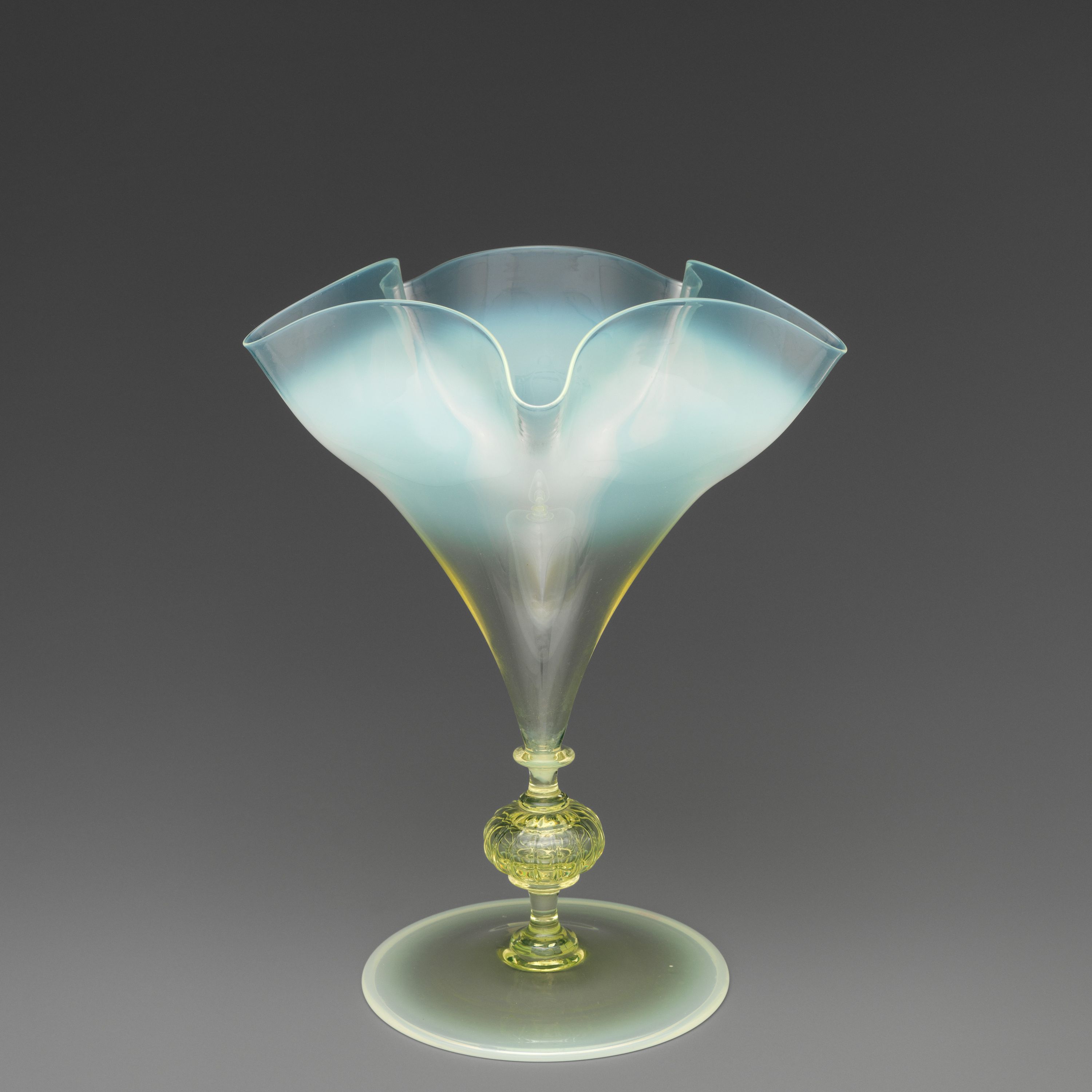
Vase with knopped stem
View on Met Museum →Description
Overview Vase with knopped stem Designer Attributed to Harry Powell British James Powell and Sons Manufacturer Whitefriars Glassworks British ca. 1880 On view at The Met Fifth Avenue in Gallery 516 This vase is a very fine example of the series of vases designed by Harry Powell (grandson of the wine-merchant, James Powell, who had purchased the Whitefriars Glassworks in 1834). Harry Powell’s designs of the 1880s and '90s created a whole group of decorative vessels characterized by delicately wavy-rimmed bowls and subtly tinted glass. The silhouette of the vase and fineness of the glass, accentuated by the ruffles of the bowl, is inspired by Venetian cristallo. The fluid design of the delicately regular waves of the bowl is testament to the skill of the Whitefriars’ glassmakers and to Powell’s confidence in their craftsmanship, achieved by gently manipulating the molten glass with a crimping tool. In later years, this effect would be taken to its logical conclusion, by replacing the use of the crimping tool by a more natural formation of waves in the bowls achieved by holding the partially-shaped molten glass upside down on the blowpipe and swinging it out to create the forms.
This vase exemplifies the core philosophy of James Powell & Sons to prize glassmakers’ technique and celebrate the colors and property of their material, rather than to simply depend upon surface decoration and embellishment. At the opposite end of their spectrum of production, James Powell & Sons also used the colors and format of this group of vases’ bowl designs to great and influential effect in more functional glassware as the bowls for oil lamps. View more