Description
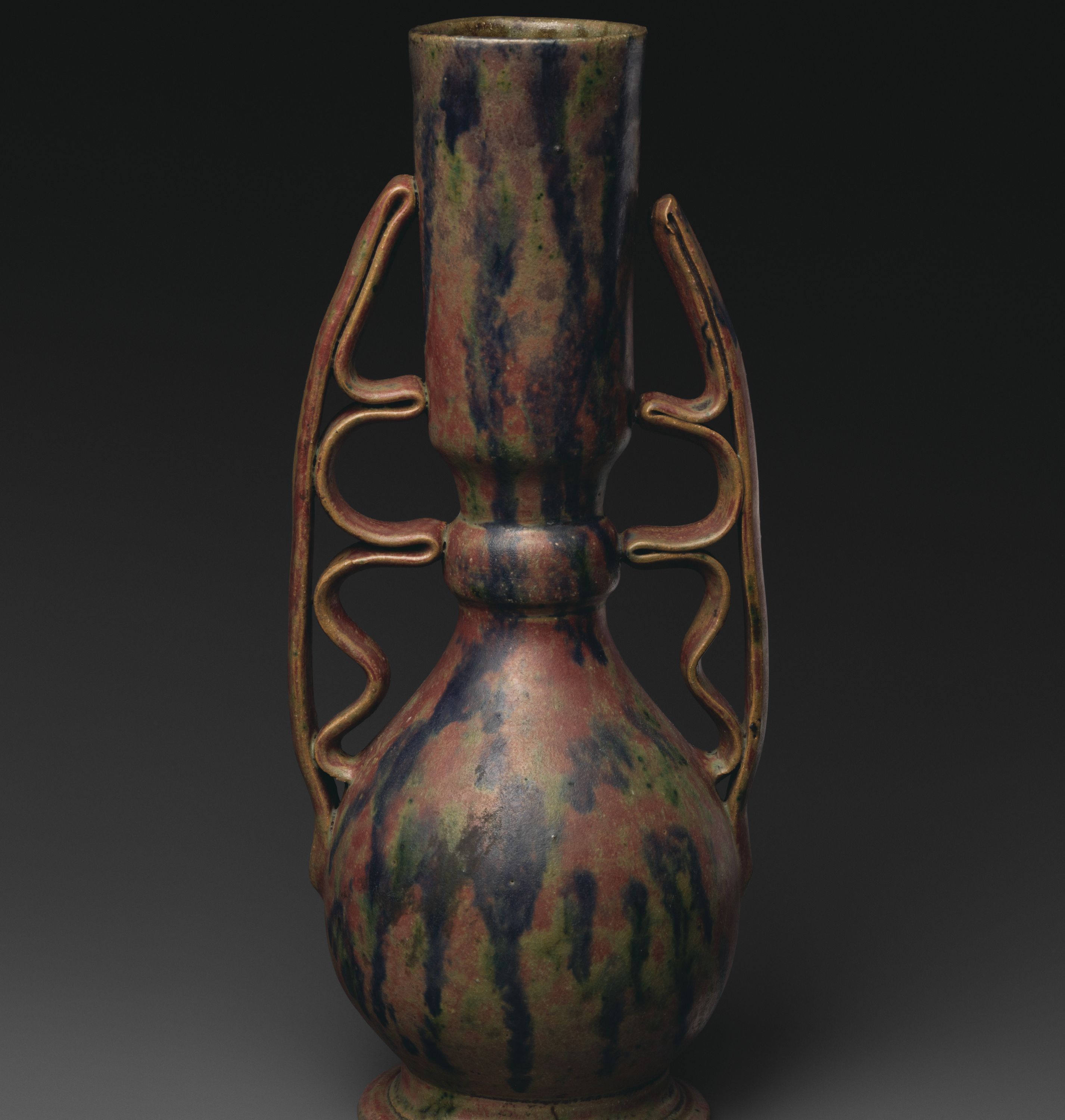
Overview Vase George E. Ohr American ca. 1897–1900 On view at The Met Fifth Avenue in Gallery 774 George Ohr of Biloxi, Mississippi, was arguably the quintessential American art potter: he built his own kiln, dug his clay, threw his vessels with extreme proficiency on the potter’s wheel to wafer thinness, altered those shapes, and then covered them with his own novel glazes. In form and decoration they are essentially Abstract Expressionist objects—almost 50 years before that movement was founded. These two vases illustrate especially well how Ohr’s lithe, flamboyant, ribbon handles transform a traditional vessel form. On one, the addition of the serpentine handles—with five points where the interior of the handle attaches to the body of the vase—give the vessel an entirely new profile. The second vase exhibits not only Ohr’s unusual serpentine handles, but also his fascination with altered form, where he squeezed and pinched the upper portion to form a double-necked vessel. The handles almost give the impression of wings attached to the slender waist of the vase. In both examples, the handles are reminiscent of the extravagant dragon stems on Venetian glass goblets.
The glazes on these vases also exhibit Ohr’s novel glazes, most of which were unlike anything ever seen in American ceramics at that date. The orange glaze is a hue that harks to the palette of Fauvist painting; the other vase, in an expression of Ohr’s disregard for convention, features two different glaze treatments, one on the front and the other on the back. View more